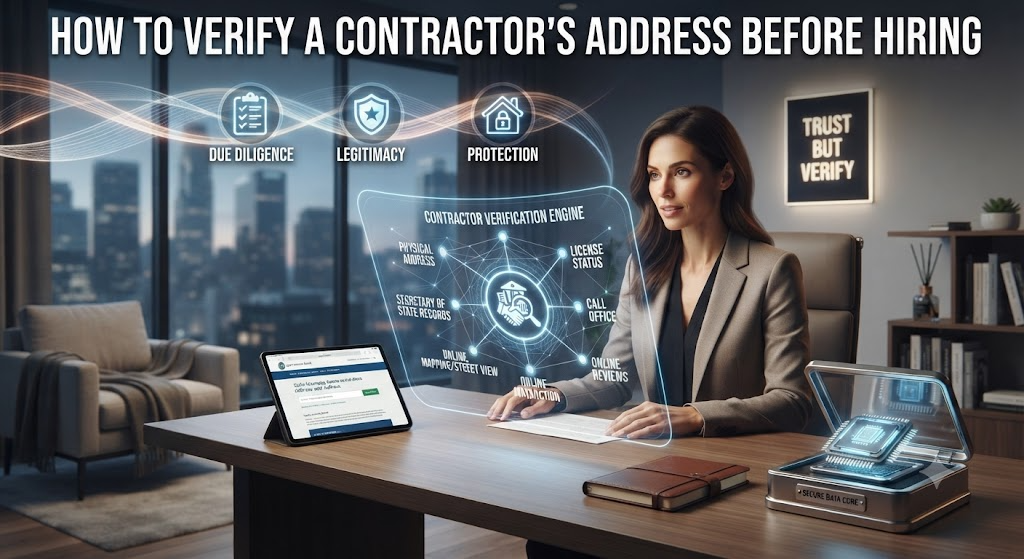
Letting a stranger into your home to work on your property is one of the biggest trust exercises a homeowner faces. You hand over access to your space, your schedule, and often a significant amount of money – all based on a business card, a website, and a handshake. But what happens when the contractor’s information turns out to be incomplete, outdated, or flat-out wrong? The consequences range from frustrating to financially devastating. That is why verifying a contractor’s address before work begins is not just a smart habit – it is an essential step in protecting your property and your peace of mind.
Why a Verified Address Matters More Than You Think
A legitimate, verifiable business address is one of the clearest indicators that a contractor is operating a real, accountable business. When a contractor provides a physical address, they are creating a paper trail – a way for you, licensing boards, insurance companies, and courts to locate them if something goes wrong. Fly-by-night operators and unlicensed tradespeople often work without a fixed address, use a P.O. box as their primary contact, or list an address that belongs to someone else entirely.
If a dispute arises after the work is done – a roof leak, faulty electrical wiring, or an unfinished project – knowing where your contractor is actually located gives you real options for recourse. Without a verified address, you may find yourself with no way to contact them and no legal standing to pursue recovery.
Your Step-by-Step Address Verification Checklist
Step 1: Collect Their Business Information Upfront
Before any conversation about pricing or timelines, ask every contractor for the following:
- Full legal business name and any trade name (DBA)
- Physical business address – not just a P.O. box
- Primary contact name and phone number
- Contractor license number
- Proof of liability insurance and workers’ compensation
A contractor who hesitates or refuses to provide this basic information is already showing you a red flag. Established professionals understand that homeowners ask these questions and welcome the opportunity to demonstrate credibility.
Step 2: Cross-Check the Address Against Public Records
Once you have an address in hand, do not simply take it at face value. Run it against multiple sources. Your state’s contractor licensing board is a great starting point – most states maintain searchable online databases where you can confirm that a license is active and tied to a specific business address.
You can also use a people search tool to find address by name, which lets you cross-reference the contractor’s name against current and past addresses. This is particularly useful when you want to confirm that the address they provided actually corresponds to the individual or business owner running the operation – not a random location or a former address that is no longer valid.
Step 3: Look Up the Business Through Official Channels
Most states require contractors to register their businesses with a secretary of state’s office or a business licensing authority. These registrations are public record and often include the registered agent’s address, the date the business was formed, and its current standing. A quick search using the business name can tell you a lot about whether you are dealing with a real, ongoing enterprise or a recently formed shell.
Check whether the business has any complaints filed against it through your state’s attorney general or consumer protection office. Even one or two unresolved complaints involving address discrepancies or contract disputes should give you pause.
Step 4: Verify Their Insurance at the Listed Address
Insurance certificates are easy to fake. Ask the contractor to have their insurance provider send a certificate of insurance directly to you – not just hand you a printed copy. Call the insurance company using a number you look up independently to confirm the policy is current, active, and tied to the same business entity and address listed on the contract.
Discrepancies between the business address on the license, the address on the insurance certificate, and the address the contractor gave you verbally are worth investigating before you sign anything.
Step 5: Use Property and Business Intelligence Tools
If you are dealing with a contractor who operates a commercial space or lists a business office, you may also want to verify what you can find about that property itself. Using a free property search tool can help you confirm ownership details and ensure the address corresponds to a real, occupied commercial property rather than a vacant lot or residential address being misrepresented as a business location.
This kind of due diligence is especially valuable when contractors claim to operate out of a professional office or showroom and you want to verify that before making a large deposit.
Red Flags to Watch For During Verification
- The address provided leads to a vacant property or empty field
- The business name does not appear in any state registration database
- The contractor’s name does not match any current address associated with the business
- Insurance documentation lists a different company name or address
- The contractor cannot produce a license number or their number returns no results
Building Your Verification Habit Before Every Hire
Address verification should not feel like an accusation – it should feel like routine. Frame it as part of your standard homeowner process. Let the contractor know upfront that you do this with every hire, and that once their information checks out, you are ready to move forward quickly. Most honest contractors will appreciate the professionalism.
The few extra hours you spend verifying a contractor’s address, license, and insurance can save you thousands of dollars and months of legal headaches. Make it part of your pre-hire checklist every single time – no exceptions.

- Crusado Casino for Beginners: Essential Information About Game Categories, Registration Requirements, Bonus Conditions, Account Security, and Online Casino Guidelines - October 14, 2026
- The 10 Best Digital Marketing Agencies in NYC for Brands Competing in High-Cost, High-Intent Markets - October 9, 2026
- TV And What Makes It Worth Exploring - October 9, 2026